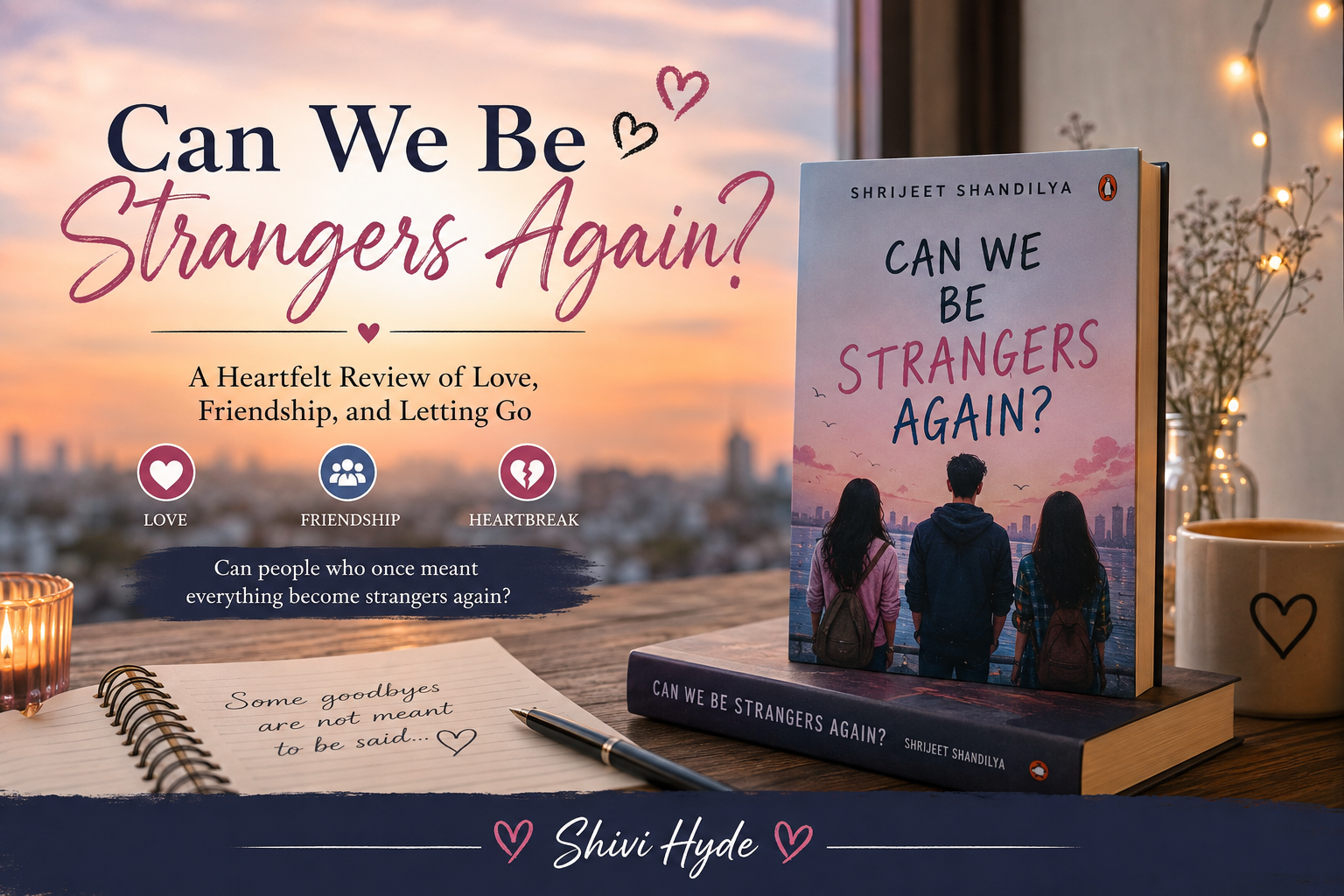
There are some questions that sound simple until you have actually lived through them.
Can we be strangers again?
It sounds like something you might casually ask after a breakup. But think about it for a moment. How do you become a stranger to someone who knows your habits, your insecurities, your favorite conversations, your worst days, and perhaps a version of you that nobody else ever got to see?
That question sits at the heart of Can We Be Strangers Again? by Shrijeet Shandilya, a contemporary romance that explores love, friendship, betrayal, confusion, and the difficult process of letting go.
The novel follows three college friends—Dev, Avantika, and Tanishka. Their friendship begins with the kind of closeness many people experience during college: late-night conversations, shared memories, emotional dependence, and the feeling that these people will somehow remain part of your life forever.
But relationships rarely stay that simple.
When friendship starts turning into love, feelings become complicated, choices begin to hurt, and the people involved have to deal with consequences they never expected.
Published by Penguin’s Ebury Press in its 2025 edition, the novel runs for 232 pages and is described by the publisher as a story of love, loyalty, betrayal, and letting go.
What Is Can We Be Strangers Again? About?
At its core, Can We Be Strangers Again? is about relationships that refuse to fit into neat categories.
The story revolves around Dev, Avantika, and Tanishka, three college friends whose bond changes when romance enters the picture. What begins as friendship slowly becomes tangled with attraction, love, jealousy, betrayal, and regret.
Dev finds himself caught in an emotionally complicated situation. The choices he makes affect not only his romantic relationships but also the friendships that once felt almost unbreakable.
The interesting part is that the novel doesn’t simply ask, “Who should Dev choose?”
It asks something much more uncomfortable:
What happens when the person you love and the person you cannot afford to lose are no longer the same person?
That is where the story gets its emotional weight.
Why Does the Story Feel So Relatable?
One of the biggest strengths of Can We Be Strangers Again? is its familiarity.
You don’t necessarily need to have experienced the exact same relationship drama as the characters to understand what they are feeling.
Most of us have had someone we once talked to every day and now barely speak to. Maybe it was a childhood friend. Maybe it was a college friend. Maybe it was someone we thought would always be around.
And sometimes, there isn’t even a dramatic ending.
A few misunderstandings happen.
Conversations become shorter.
Messages stop coming.
People move on.
Suddenly, someone who was once a huge part of your daily life becomes a name you hesitate to text.
That’s the emotional space this novel explores.
A review on StoryGraph similarly describes the book as relatable, particularly in its college-and-friendship elements, while noting its emotional and character-driven nature.
Dev, Avantika and Tanishka: The Emotional Triangle
The three central characters are what keep the story moving.
Dev
Dev is at the center of the story, and much of the emotional conflict comes from his decisions.
He is not a perfectly composed romantic hero. He makes mistakes, misunderstands his own feelings, and sometimes realizes the importance of people only after things have already changed.
That makes him frustrating at times—but also human.
And perhaps that’s the point.
People don’t always make the right decision when emotions are involved.
Avantika
Avantika adds another layer to the story because her relationship with Dev changes the dynamics of the friendship.
What begins as familiarity becomes something more complicated, and once romantic feelings enter the equation, the old friendship becomes difficult to recover.
Tanishka
Tanishka represents another side of the emotional conflict.
Her presence makes Dev’s choices more difficult, but she also highlights one of the novel’s central ideas: sometimes we understand someone’s importance only after we have taken their presence for granted.
That feeling of realizing something too late is painfully familiar.
The Biggest Question: Can We Really Become Strangers Again?
This is where the title becomes more than just a catchy phrase.
Can two people who have shared so much genuinely return to being strangers?
Probably not.
You can stop talking.
You can delete messages.
You can unfollow someone.
You can pretend that you don’t care.
But memories don’t have an unfollow button.
Once somebody has been important to you, they leave something behind. It may be a lesson, a memory, a scar, or simply a different version of yourself.
That’s why the question in the title feels so personal.
Maybe becoming strangers isn’t really about forgetting someone.
Maybe it is about accepting that the relationship you once had no longer exists.
Love vs. Infatuation: A Question Worth Thinking About
Another interesting aspect of the novel is its exploration of the difference between love and attraction.
When you’re young, strong emotions can feel like love.
You think about someone constantly.
You want their attention.
Their messages can change your entire mood.
You imagine a future together.
But is that necessarily love?
Or is it infatuation?
The novel doesn’t make this question feel like a psychology lesson. Instead, it lets the characters experience the confusion themselves.
And honestly, that’s much closer to real life.
Most people don’t sit down and carefully analyze whether they are experiencing love, attachment, loneliness, or attraction.
They simply feel it.
And sometimes they understand what they were feeling only after the relationship has already changed.
The College Setting Makes Everything More Intense
College friendships have a strange kind of intensity.
You can meet someone and within months feel as though you’ve known them forever.
You spend hours together. You share food, jokes, secrets, frustrations, assignments, celebrations, and random conversations at impossible hours.
The world feels smaller.
Your friends become your support system.
That is why losing a friendship during college can hurt just as much as losing a romantic relationship.
Can We Be Strangers Again? uses this environment effectively. The story’s college setting gives the relationships a sense of immediacy, while the pandemic-era backdrop adds another interesting layer to the characters’ experiences.
The Writing Style: Simple, Emotional and Easy to Read
Shrijeet Shandilya’s writing is aimed at readers who enjoy accessible contemporary romance rather than extremely complicated literary fiction.
The emotional situations are familiar, the language is approachable, and the story moves through relationships rather than relying heavily on an elaborate plot.
That makes the book particularly approachable for young readers and people who are getting into Indian contemporary romance.
Some readers have praised its fast-paced and emotional quality, while others have criticized aspects of the characterization and timeline structure.
And that’s worth mentioning because no book works the same way for everyone.
A story that feels deeply relatable to one reader can feel predictable to another.
What Makes This Book Stand Out?
The biggest attraction of Can We Be Strangers Again? isn’t necessarily a groundbreaking plot.
It’s the emotional familiarity.
The book talks about something most people understand: losing people.
Not always through death.
Sometimes through distance.
Sometimes through betrayal.
Sometimes because two people simply grow in different directions.
And sometimes because we make decisions that cannot be undone.
The publisher describes the novel as a moving story about love, loyalty, and the bittersweet beauty of letting go. That description captures much of what makes the book emotionally appealing.
Is Can We Be Strangers Again? Worth Reading?
If you’re looking for a complicated literary romance with an exceptionally intricate plot, this may not be the book you’re searching for.
But if you enjoy emotional romance, college friendships, relationship drama, heartbreak, and stories that leave you thinking about your own past, it is worth considering.
The book is relatively short at around 232 pages, so it is also an easy choice for readers looking for a quick contemporary romance.
What makes it interesting is that you may not agree with every character’s decision.
In fact, you might get annoyed with them.
But isn’t that what happens with people we know in real life too?
We don’t always understand their choices.
Sometimes we don’t even understand our own.
Final Thoughts: Some People Don’t Become Strangers
After finishing Can We Be Strangers Again?, the title stays with you.
Maybe because there isn’t a perfect answer.
Can you become strangers again?
Technically, yes.
Emotionally, probably not.
You can stop calling someone. You can stop meeting them. You can build a completely different life. Years can pass.
But if that person once mattered to you, some small part of that relationship remains.
And perhaps moving on isn’t about turning someone into a stranger.
Perhaps it’s about remembering them without wanting them back.
That’s what makes Can We Be Strangers Again? by Shrijeet Shandilya more than just another college romance. Beneath the love triangle and heartbreak is a simple reminder: some relationships end, but the version of ourselves that existed inside them doesn’t disappear completely.
Sometimes, people leave.
Sometimes, we let them go.
And sometimes, the only thing left to ask is whether we can live with the memories.
Frequently Asked Questions
1. Who wrote Can We Be Strangers Again??
Can We Be Strangers Again? was written by Shrijeet Shandilya. It is his debut novel and explores love, friendship, loss, and growing up.
2. What is Can We Be Strangers Again? about?
The novel follows three college friends—Dev, Avantika, and Tanishka—whose friendship becomes complicated when romantic feelings enter their lives. The story explores love, betrayal, friendship, regret, and letting go.
3. Is Can We Be Strangers Again? a romance novel?
Yes. The book falls under contemporary romance/new adult fiction, but it also focuses heavily on friendship, emotional conflict, and personal growth.
4. Is Can We Be Strangers Again? suitable for young readers?
The book is particularly likely to appeal to older teenagers and young adults who enjoy college romance, friendship stories, and emotionally driven fiction. Readers should consider the relationship and emotional themes before choosing it for younger audiences.
5. Why is Can We Be Strangers Again? relatable?
The novel deals with experiences many people recognize—friendship turning complicated, confusing attraction with love, making emotional mistakes, losing someone close, and trying to move forward after a relationship changes.
Final Verdict
Can We Be Strangers Again? is a relatable, emotional contemporary romance about the messy space between friendship and love.
It won’t necessarily be everyone’s perfect romance novel, but its central question is difficult to ignore:
After knowing someone so deeply, can you ever really become strangers again?
Maybe not.
And perhaps that’s exactly what makes the question worth asking.