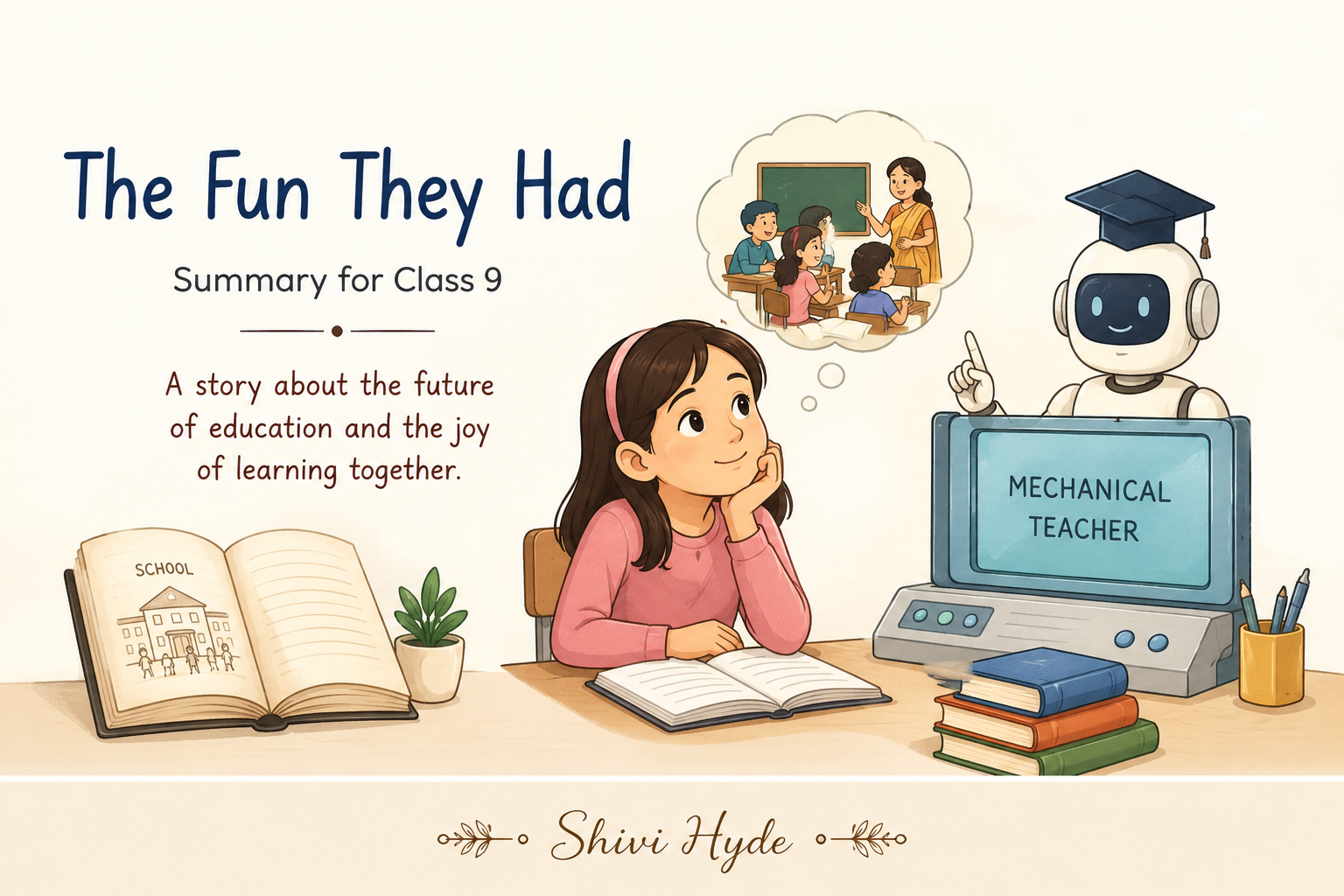
The Fun They Had is a popular science-fiction story written by Isaac Asimov and included in the CBSE Class 9 English syllabus. The story takes readers into a futuristic world where children no longer attend traditional schools. Instead, they study at home with the help of mechanical teachers.
Through the characters of Margie and Tommy, Asimov compares modern technology-based education with the traditional school system. The story makes us think about whether technology can truly replace the human connection, friendship, and happiness that come with learning together.
The Fun They Had – Introduction
The story is set in the year 2157. Thirteen-year-old Margie lives in a world where children receive individual education at home. Their teachers are machines that provide lessons, conduct tests, and assign homework.
Margie does not particularly enjoy studying with her mechanical teacher. She has been struggling with geography, and the machine keeps giving her tests. Her marks have been getting worse, which makes her frustrated.
One day, her friend Tommy, an eleven-year-old boy, finds something very unusual—a real printed book. In their futuristic world, books are read on screens, so Margie and Tommy are fascinated by the old book.
The Discovery of the Old Book
Tommy finds the book in his house and proudly shows it to Margie. The children are surprised by its appearance. The pages are yellow and crinkly, and the words are printed permanently on the pages.
For Margie, this is especially strange because she is used to reading words on a screen. She cannot understand why anyone would want to read a book that cannot be changed or moved.
Tommy explains that the book is about schools from the past. Margie becomes curious because she has never experienced a traditional school.
Margie’s Mechanical Teacher
Margie strongly dislikes her mechanical teacher, especially because of her poor performance in geography. The machine has been giving her difficult tests, and her marks keep falling.
Her mother becomes worried and calls the County Inspector to examine the machine.
The Inspector carefully checks the mechanical teacher and discovers that its geography section has been set too fast for Margie’s level. He repairs it and adjusts it to the appropriate level.
Margie hopes that the Inspector will take the machine away permanently, but he tells her mother that it is working properly. He also assures her that Margie’s performance is normal for her age.
After the Inspector leaves, Margie has to continue her lessons with the mechanical teacher.
What Were Schools Like in the Past?
Tommy tells Margie about the old schools described in the book. In the past, children went to a school building where they studied together.
Margie finds this idea almost unbelievable. She cannot imagine why children would need to leave their homes to study when they could simply learn from a teacher at home.
Tommy explains that children of the same age went to school together. They learned the same subjects from a human teacher.
This seems very strange to Margie. She is accustomed to having a mechanical teacher that teaches her individually according to her level.
The Difference Between Old and Future Schools
The biggest difference between the two systems is the presence of human interaction.
In Margie’s world, children study alone at home. Their mechanical teachers are efficient and can adjust lessons according to individual needs. However, the children do not get to sit with classmates, share experiences, or enjoy school activities together.
In the old system, children went to school together. They could talk, play, help each other, and learn from a human teacher.
Margie begins to imagine what such a school would have been like. She pictures children sitting together in a classroom and enjoying their lessons.
The Importance of Friendship and Human Teachers
The story shows that education is not only about receiving information or getting good marks. The social and emotional aspects of learning are equally important.
A mechanical teacher can provide lessons and tests, but it cannot completely replace the encouragement, understanding, and personal connection provided by a human teacher.
Similarly, studying alone may be convenient, but children also need friends. Sharing jokes, solving problems together, playing during breaks, and making memories are important parts of growing up.
Margie slowly realizes that children in the past may have enjoyed school much more than she does.
The Ending of The Fun They Had
At the end of the story, Margie returns to her lesson because her mechanical teacher is ready to teach her.
However, her thoughts remain focused on the old schools. She imagines children entering a school building together, sitting in classrooms, learning from human teachers, and spending time with their friends.
She thinks about how much fun those children must have had.
This thought explains the title “The Fun They Had.” Margie realizes that the children of the past had something special—the opportunity to learn and grow together.
Themes of The Fun They Had
Technology and Education
The story explores how technology can completely transform education. It also reminds us that technological progress does not necessarily mean that every traditional practice should disappear.
Human Connection
Human teachers provide emotional support and understanding that machines cannot fully reproduce. The story highlights the value of personal interaction in education.
Friendship
Friendship is an important part of childhood. Studying with classmates can make education more enjoyable and memorable.
Traditional vs. Modern Education
Asimov compares two very different educational systems. The futuristic system is technologically advanced, while the traditional system provides greater social interaction.
Message of The Fun They Had
The main message of the story is that technology can improve education, but it should not completely replace human interaction.
The story encourages us to appreciate teachers, classmates, friendships, and the shared experiences that make school life special. It also reminds us that education should develop a child’s social and emotional skills, not just academic knowledge.
Frequently Asked Questions
1. Who wrote The Fun They Had?
The Fun They Had was written by Isaac Asimov, a famous American science-fiction writer.
2. Who are the main characters in The Fun They Had?
The main characters are Margie and Tommy. Margie is thirteen years old, while Tommy is eleven. The story also features Margie’s mother, the County Inspector, and Margie’s mechanical teacher.
3. What is The Fun They Had about?
The story is about two children living in the future who discover how children studied in the past. They learn that students once attended schools together and were taught by human teachers.
4. Why did Margie hate her mechanical teacher?
Margie disliked her mechanical teacher because it gave her frequent tests and had been causing problems in geography. She found studying with the machine frustrating and boring.
5. What is the main theme of The Fun They Had?
The main theme is the importance of human interaction, friendship, and traditional classroom learning. The story also explores the role of technology in education.
6. Why is the story titled The Fun They Had?
The title refers to Margie’s realization that children in the past probably enjoyed school because they learned together, interacted with friends, and were taught by human teachers.
Conclusion
The Fun They Had is more than just a story about futuristic education. It encourages students to think about what makes learning enjoyable and meaningful. Although technology can make education personalized and convenient, the story reminds us that teachers, friends, classroom experiences, and human relationships are equally valuable.
Through Margie’s imagination, Isaac Asimov leaves readers with an important thought: sometimes, the simple experiences we take for granted—like sitting in a classroom with friends—can be the things we remember and value the most.