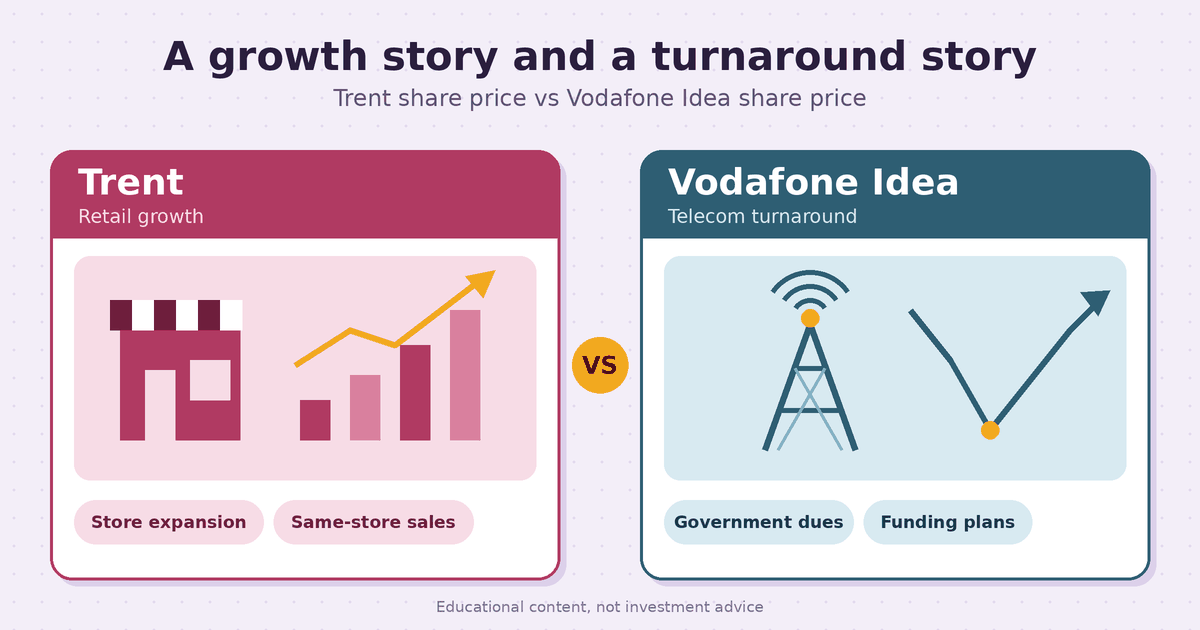
Some stock comparisons are easy because the companies look alike. This one is the opposite. Trent sells clothes and everyday fashion. Vodafone Idea sells mobile connectivity. One is known for steady expansion, the other for a long struggle with debt. Yet both attract a lot of attention from Indian investors, often for very different reasons.
If you have been watching the Trent share price and the Vodafone Idea share price, this guide explains what each business does, what moves the stock, and why the two call for very different kinds of homework.
Two companies, two very different stories
Trent is a Tata Group retail company. It is best known for Westside, its apparel and lifestyle chain, and Zudio, its value fashion format that has grown quickly across many towns and cities. It also runs a grocery and daily needs business. The core appeal is simple: a retailer that keeps opening stores, keeps customers coming back, and has been able to grow while controlling costs.
Vodafone Idea is one of India’s three large private telecom operators, alongside Jio and Airtel. It was formed by merging two older telecom companies, and it has carried a heavy debt load for years. Part of that burden comes from a Supreme Court ruling on adjusted gross revenue (AGR), which decided how much telecom firms owe the government in licence fees.
Put simply, Trent is mostly a story about how fast a healthy business can grow. Vodafone Idea is mostly a story about whether a stretched business can stabilise.
What moves the Trent share price
Store expansion. New Westside and Zudio stores feed directly into sales growth. Investors watch how many stores are added and how well they perform.
Same-store sales. This shows whether existing stores are selling more over time, which says more about customer demand than store count alone.
Consumer spending. Fashion is a discretionary purchase. When household budgets feel stretched, people may postpone buying clothes.
Valuation. Strong growth often brings a high price relative to earnings. That means expectations are already built in, and any slowdown can hit the stock hard.
Costs and margins. Rents, wages, and the cost of sourcing products all matter for profit.
What moves the Vodafone Idea share price
Government dues and policy. This is the biggest swing factor. The government converted part of the company’s spectrum dues into equity, taking its stake to about 49 percent, as reported in 2025. A later relief package approved by the Union Cabinet reportedly froze the AGR dues of ₹87,695 crore and moved their repayment to a ten-year window between FY32 and FY41. Headlines on this topic can move the stock sharply in either direction.
Fundraising. The company has said it needs funding to invest in its network. Whether it can raise money from banks or other sources affects how investors view its future.
Subscribers and revenue per user. In telecom, keeping customers and earning more from each one is crucial. Tariff changes by the three big operators can shift the picture.
Network investment and 5G. Competing for customers means spending on towers, spectrum, and technology, which requires cash that the company has to find.
Debt levels. Interest and repayment obligations weigh on profit and give the company less room for error.
A quick comparison
| Trent | Vodafone Idea | |
|---|---|---|
| Sector | Retail (fashion, lifestyle, grocery) | Telecom |
| Group | Tata Group | Aditya Birla Group, Vodafone Group, and the government as shareholders |
| Main story | Store-led growth | Turnaround and survival |
| Key driver | Consumer demand, store expansion | Government dues, funding, subscriber trends |
| Main risk | High expectations, discretionary spending | Heavy debt, competition, dependence on policy support |
Why a low share price does not mean a bargain
Here is a mistake that shows up again and again, and it matters especially with Vodafone Idea. Many beginners see a share priced at a small number of rupees and think it must be cheap or easy to profit from. A low price per share does not say anything about value. It only reflects how many shares exist and what the market currently pays for them.
On the other side, a higher share price like Trent’s does not make the company expensive by itself. What counts is the price compared with earnings, assets, and future growth.
What to check for each company
For Trent:
- Revenue growth and store additions over several quarters
- Same-store sales trends
- Operating margins
- Price-to-earnings ratio compared with its own history and with other retailers
For Vodafone Idea:
- Latest status of government dues and any policy changes
- Debt, interest costs, and funding plans
- Subscriber numbers and average revenue per user
- Whether the company is generating cash or still depending on outside funding
These lists are different on purpose. A growth retailer and a debt-heavy telecom should not be judged by the same yardstick.
Which kind of investor looks at which stock?
Trent tends to attract people who like businesses with a visible growth path and are comfortable paying a premium for it. The risk is that a premium price leaves little cushion if growth slows.
Vodafone Idea tends to attract people who are willing to take a higher level of risk in the hope of a recovery. The outcome depends heavily on factors outside investors’ control, such as government decisions and the company’s ability to raise money. Anyone considering it should be prepared for sharp moves and should size the position carefully.
Some investors never touch the second kind of stock, and that is a perfectly sensible choice.
A simple routine before you invest
- Read the latest quarterly results of the company.
- Understand how it makes money in plain words.
- Check debt and cash flow, not just profit.
- Compare valuation ratios with its history and its sector.
- Decide how much of your portfolio this one stock should represent, and stick to it.
- Use fresh data from a reliable source, because prices change every day.
Final thoughts
The Trent share price and the Vodafone Idea share price may sit side by side on a watchlist, but they tell completely different stories. One is about growing a healthy business. The other is about repairing a heavily indebted one. Understanding which story you are buying, and whether you can live with the risks that come with it, matters far more than following the daily price.
Do your homework, keep your position sizes sensible, and invest in line with your own goals.
Disclaimer: This article is for educational purposes only and is not investment advice. Investments in the securities market are subject to market risks. Please read all related documents carefully and consult a SEBI-registered advisor before investing.